
Vacaville, CA · Garage Door Service
Garage Door Spring Repair Across the Vacaville Area
Broken torsion spring on a Vacaville garage door? We explain what a repair job looks like, what you can safely check yourself, and why springs fail here.
- Repairs & new doors
- Springs & openers
- Serving 4 nearby communities
The Cost of This Job
We're not going to throw a number at you that doesn't match your door, because spring repair cost swings on a few things: whether it's one torsion spring or a pair, the spring's wire size and wind, whether the drum or bearing plate is worn too, and whether your opener's logic board took a hit when the spring let go. A single spring on a lighter one-car door is a different job than replacing both springs on a heavier double door that's been carrying extra insulation or a decorative overlay.
What we can tell you honestly: if your door was installed with the home, somewhere in that 1974-2002 build window common across Vacaville's older tracts, the spring hardware is original or a prior replacement nobody kept records on. That means the cable drums, bearing plate, and center bracket often need a look even if the spring itself is the only thing that broke. A quote that only covers the spring and misses a worn bearing plate is a quote you'll pay twice.
One limitation worth saying plainly: we don't guess over the phone. Spring size and door weight matter enough that a wrong tension setting on a torsion spring can mean a door that slams shut or won't stay open, so we measure on site before we commit to a number.
What You Are Seeing
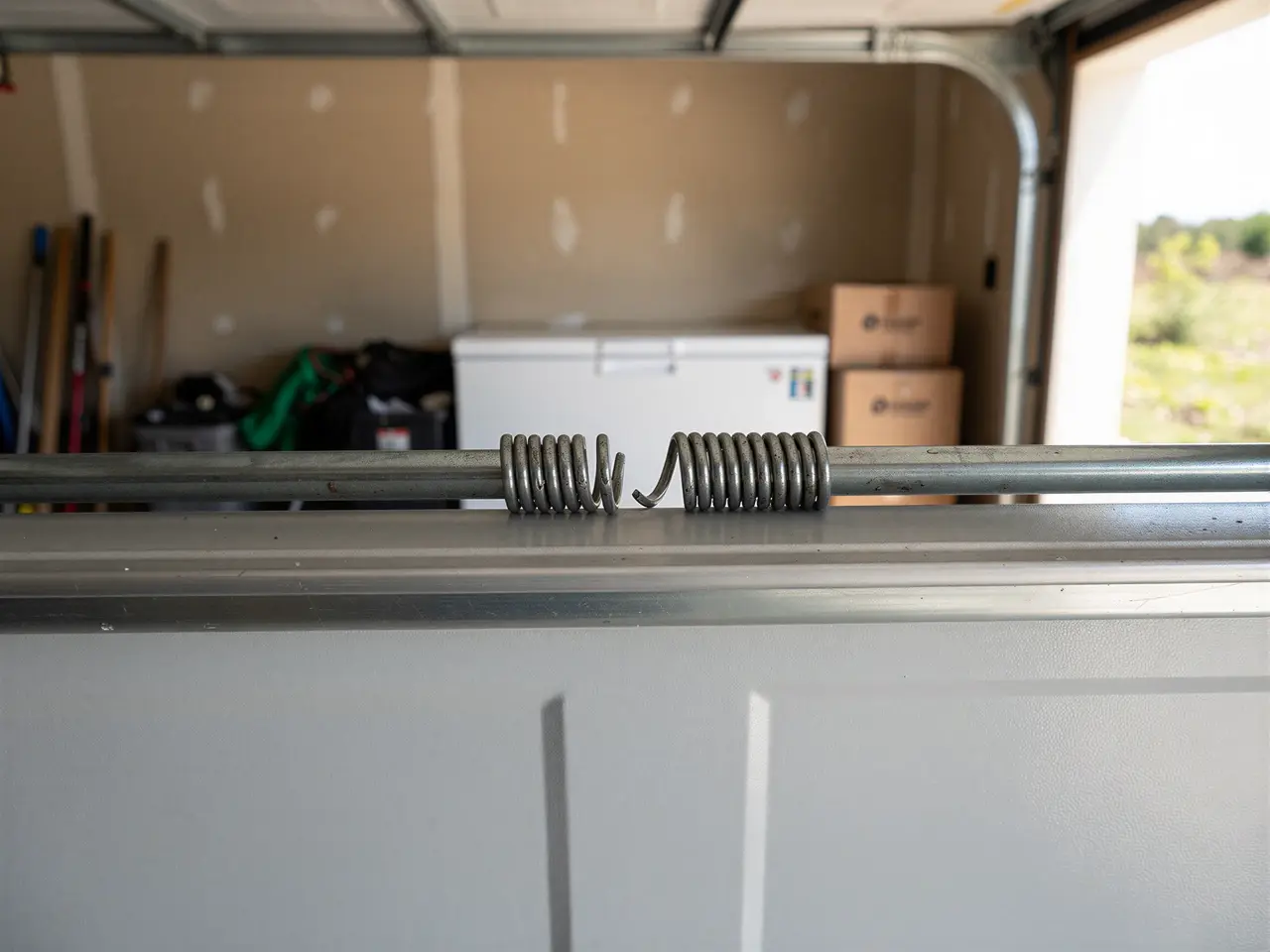
A torsion spring usually fails one of two ways. Either it snaps clean, usually with a loud bang you'll hear from inside the house, and the door won't budge or feels like it weighs 300 pounds when you lift it by hand. Or it fatigues slowly, and you notice the opener straining, the door closing crooked, or a gap opening up in the coil where a crack has started.
Extension springs, the kind stretched along the horizontal tracks above older single-panel or sectional doors, tend to fail differently. They sag, lose tension unevenly side to side, or a cable at one end frays and lets go, which is why the door drops faster on one side than the other.
If you're hearing a grinding or popping sound before anything actually breaks, that's usually the spring already cracked internally and running on borrowed time, not a lubrication problem. Don't keep running the opener through it. A spring under tension that lets go while someone's hands are near the drum or cable is how people get hurt.
Can You Do This Yourself
Garage door springs are the one part of this job we tell homeowners flatly not to touch. A torsion spring holds enough stored tension to break bones or worse if it's wound or unwound with the wrong tools, and the winding bars for it aren't something most garages have lying around. Extension springs are lower tension but still dangerous without the safety cables that keep a broken spring from becoming a projectile.
What you can safely do: disconnect the opener by pulling the emergency release cord so you're not forcing a motor against a dead spring, and leave the door down and the vehicle out of the garage until someone can look at it. You can also check whether the spring is torsion-style (horizontal bar above the door, directly over the closed door's center) or extension-style (springs stretched along the upper tracks), since that tells a technician what parts to bring.
If your household runs 51,903 strong across this service area and a good share of those houses are owner-occupied with a two-car garage on a single torsion bar, we'd guess a fair number of you have thought about doing this yourself to save a service call. Don't. This is the one repair where the math doesn't favor DIY.
Why It Happens Here
Most of the housing stock across Vacaville's established neighborhoods went up between 1974 and 2002, with a lot of it clustered in the 1980s and 90s across the nine areas that make up this market. Torsion springs installed during that build-out are rated for a certain number of open-close cycles, typically somewhere around 10,000, and doors from that era are now thirty-plus years into daily use. That's past the service life of the original spring in a lot of these homes, regardless of how well the door itself has held up.
The mild temperate climate here actually works in your favor compared to places with real freeze-thaw cycles or heavy humidity swings, since you're not fighting rust or ice-stiffened coils the way some regions do. But mild weather doesn't stop metal fatigue from cycling. A spring doesn't care if it's 55 degrees or 95 when it finally gives out; it cares how many times it's been wound and released.
What we see most often is simply age catching up with original equipment: a spring sized correctly in 1986 for a lighter door, now paired with a replacement door panel that's heavier, which shortens the spring's remaining life even further.
Frequently asked questions
How do I know if it's the spring and not the opener?
If the door won't lift by hand when disconnected from the opener, or lifts unevenly and feels heavy on one side, that's a spring problem, not an opener problem. An opener that runs but the door doesn't move usually points to the drive gear instead. Pulling the release cord and trying to lift manually is the fastest way to tell the two apart.
Can one broken spring on a double door wait a few days?
Technically the door may still open on a single working spring if it's a two-spring system, but the remaining spring is now carrying double the load it was sized for, which speeds up its own failure. We'd rather you call sooner than deal with two springs breaking back to back.
Do you replace just the broken spring or both?
On a two-spring system we generally recommend replacing both, since the second spring is close behind in cycle life even if it hasn't failed yet. We'll explain why on site rather than push a blanket rule that doesn't fit your door.
Related services
Related guides
Book garage door service in Vacaville
Call now or request a quote - tell us what the door is doing and where you are.